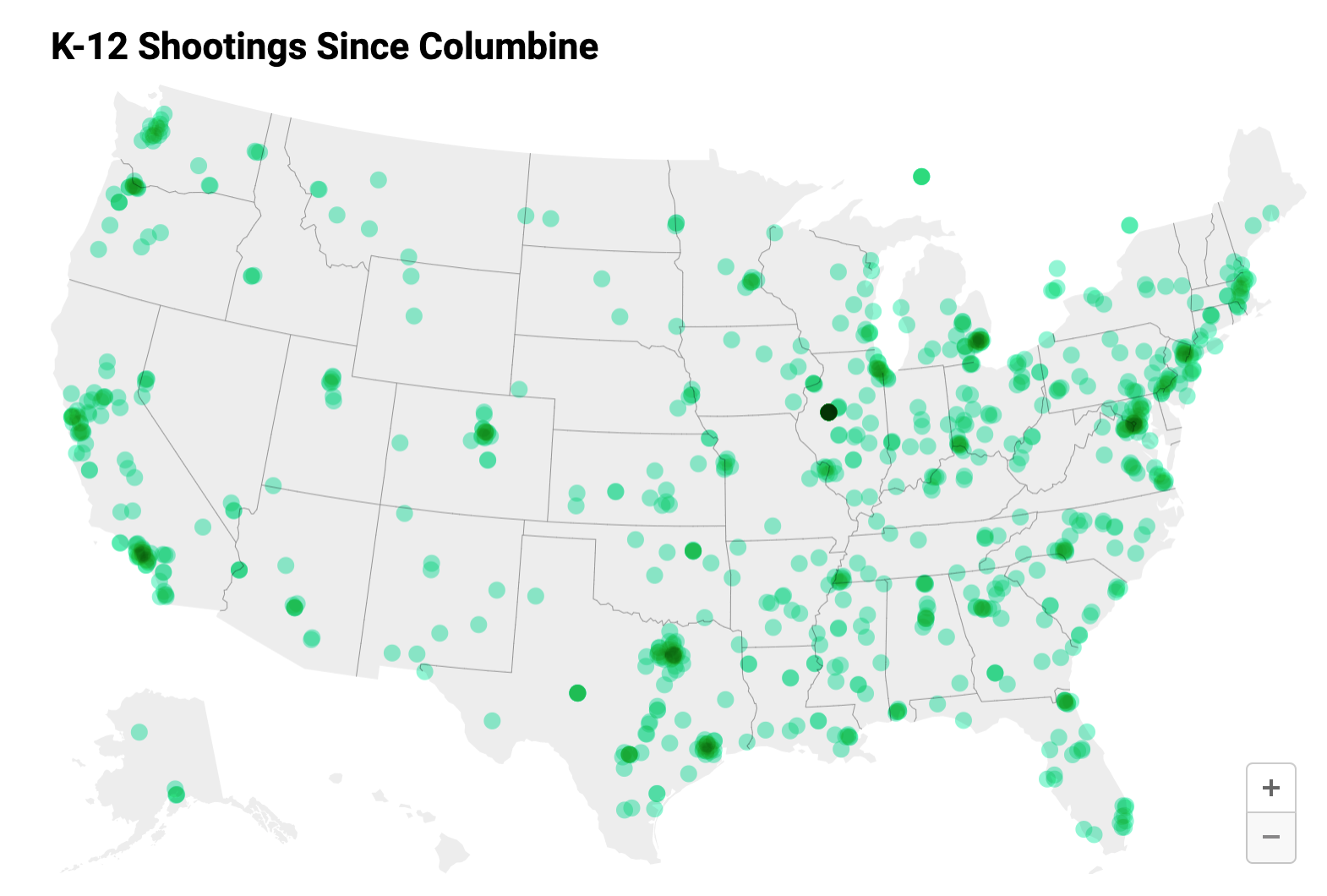
Restrictiveness of State Gun Laws is Associated with School Shootings
A generation of students has been raised to fear school shootings.
There have been over 1,000 incidents of gun violence in the United States reported in the K-12 School Shooting Database since the Columbine High School massacre on April 20, 1999. With that, comes over twenty-six hundred victims either injured or killed.
The number of children who witness the violence and/or experience PTSD and other forms of anxiety disorders due to gun violence at school is more than a staggering 248,000. Students now worry more about a shooting happening at their school than peer pressure.
Despite all the gun violence children experience in the United States, gun lobbyist groups continue to block progress in Washington. The gun lobby has long perpetuated an extremist view of the Second Amendment, with no wiggle room for common sense gun safety protections. With the right laws, school shootings can be prevented. States with stronger gun laws have less gun violence.
In response to the Stoneman Douglas High School shooting in 2018, which resulted in the deaths of 17 students, Wayne LaPieree, the CEO of the NRA called for arming teachers.
“Every day, young children are being dropped off at schools that are virtually wide-open, soft targets for anyone bent on mass murder,” said LaPieree.
Studies have shown that the risks associated with gun access vastly outweigh the likelihood of self-defense use. “Whether or not I’m pro-gun, I don’t wan’t a gun in the classroom, it puts my students in unnecessary danger.” said Toni Jones, a kindergarten teacher for DCPS.
Students across the nation already go through anxiety-inducing active-shooter drills, a gun is an added stress. “When we go into lockdown, the kids are scared because someone is tugging at the door, I have to reassure the kids they are safe, even if I can’t guarantee it,” said Jones.
Threats of an active-shooter negatively impact students’ learning and overall school experience. In addition to the emotional toll of regular drills and frequent shootings across the country, the family partnerships are also harmed. Jones notes, “New security and growing fears of threats against the school doesn’t allow for a lot of family relationships, we can’t have volunteers in the class like we used to.”
While guns in the classroom is not the answer, Jones acknowledges there is a fine line between school safety and over policing, which tends to disproportionately punish students-of-color. “The current system needs to be redesigned and reformed, so we can feel safe at school, without having to worry about which students are getting unfairly punished.”
The 2008 ruling in the District of Columbia v. Heller marked the first Supreme Court ruling on the Second Amendment in nearly 70 years. The court ruled in favor of Dick Heller who sued D.C. over its ban at handguns in the home. In the decision, Justice Scalia affirmed the individual’s right to keep handguns at one’s home for self-defense, while still stressing the limited nature of the ruling.
“Like most rights, the right secured by the Second Amendment is not unlimited. [It is] not a right to keep and carry any weapon whatsoever in any manner whatsoever and for whatever purpose.”
In regards to gun laws, states vary on everything from background check procedures to mental health reporting. The vast difference of gun laws and ownership by states attributes to gun violence. For instance, California, Massachusetts, and Connecticut have the most laws on the books all around approximately one-hundred, while Iowa and Idaho are tied for dead last.
Firearms left unsecured in the home are a major source of guns used in school shootings. With that being said, it is essential to have an accurate record of gun sales. An accurate record can help keep guns out of undesirable hands.
Child access prevention (CAP) laws encourage safe storage of firearms by holding adults accountable when children gain access to their guns. Evidence shows these laws work to prevent unauthorized firearm access. A 1997 study found that CAP laws were associated with a 23% decrease in accidental shooting death among children younger than 15-years-old. Fourteen states have implemented CAP laws, but specifics vary. The majority of states with CAP laws require the child to use the firearm.
Four states, California, Massachusetts, Minnesota, and Maryland have the strictest CAP laws that impose criminal liability when a minor is merely likely to gain access to a gun that is negligently stored.
73-percent of children under 10 living in homes with guns reported knowing the location of their parents’ firearms, and 36-percent admitted they had handled the weapons.
With over 700 thousand registered guns, Texas has the most firearms of any state. Additionally, Texas has the most school shootings in the county, per 100 thousand people. Followed by Louisiana, Delaware, and Alabama.
The states with the lowest rates of gun violence in K-12 schools, since Columbine, are Massachusetts, New York, North Dakota and Hawaii.
Based on existing gun laws, legal gun ownership, and previous school shootings, Idaho, Missouri, Iowa, Texas, and Georgia have the least amount of measures in place to prevent gun violence, when taking into account the amount of registered guns in the state.
The restrictiveness of state gun laws is associated with the rate of school shootings in the United States. This has a major impact on K-12 students. Children who experience school shootings can suffer severe anxiety and debilitating trauma.
Dr. Jill Bohnenkamp, an assistant professor and faculty at the Center for School Mental Health at the University of Maryland, spoke on the effect of living in the current climate of gun violence. Dr. Bohnenkamp has experience in school mental health research, policy and clinical practice at the local, state, and national levels. Her research focuses on school safety outcomes of school mental health service provisions and mental health training for educators.
“Pervasive gun violence contributes to feelings of unsafety in school. Teachers are integral to addressing children’s mental health needs in schools, yet they report limited training in mental health and behavior management in the classroom”, said Dr. Bohnenkamp.
The SAS estimates that American citizens own 393 million guns, making the U.S. ranked number one in firearms per capita. A majority of gun owners cite protection as their primary reason for owning a gun. A 2015 Harvard study found that people defended themselves with a gun in less than 1 percent of 14 thousand crimes from 2007-11.
By contrast, research has shown that guns in the home are far more likely to be used for suicide or homicide, rather than for self-defense.
A number of effective policy solutions can better protect children from violence. Research indicates, closing background check loopholes, investing in community-based violence intervention programs, and child access prevention laws can have positive impacts on the current rate of gun violence affecting children in the United States.