How COVID-19 Has Impacted Student Enrollment Numbers
When the COVID-19 pandemic hit the United States in early 2020, universities across the nation saw enrollment rate changes across the board after announcing classes would be held online for the Fall 2020 academic semester.
“What happened with COVID is, what we soon realized was that melt was going to be a lot higher,” Jonathan Akman, Associate Director and Business Analyst at American University, said. “And it was going to be higher for a few reason - meaning more of our enrollment deposits were going to go away.”
Akman gave insight into the reality that students, who initially were enrolling to American University, were getting pulled off of the waitlist of other universities (that ranked higher than American University by these students’ preferences of colleges to attend] due to the low enrollment rates there. Due to this, more students were not enrolling at American University in Fall of 2020 than the previous Fall semester.
Though American University saw a little difficulty with enrollment rates of students - and creating a new enrollment system around it - the District of Columbia as a whole saw an increase of enrollment numbers during the 2020 Fall academic semester for all colleges residing in the district.
In Fall of 2019, the District of Columbia saw 70,717 students confirm their enrollment to a District of Columbia college/university. In Fall of 2020, that number went up by 3% (to 72,763 enrollments) for the same category of students.
Full-Time or Part-Time (The Story of Two Students)
“I think I was mostly disappointed, because I really like the benefits of being inside of a classroom,” Ashley Lopez, a second semester Junior at American University who is in the School of Communications, said. “And having a set schedule around going to classes and being on campus, and structuring my meals around that; instead of being at home and then just logging [onto classes] without any real structure.”
Lopez was looking forwards to enjoying their Fall semester in 2020 as a full-time student. Though they had second thoughts of deciding whether they should continue to be a full-time student or become a part-time one during the summer of 2020 (when it was announced classes would be fully online), Lopez decided to continue as a full-time student to complete their academic plan on time.
“I just wanted to finish my degree on time,” Lopez said. “I did not want to finish any later than I had intended, so I was willing to go online [full-time]; even if it meant being more stressed.”
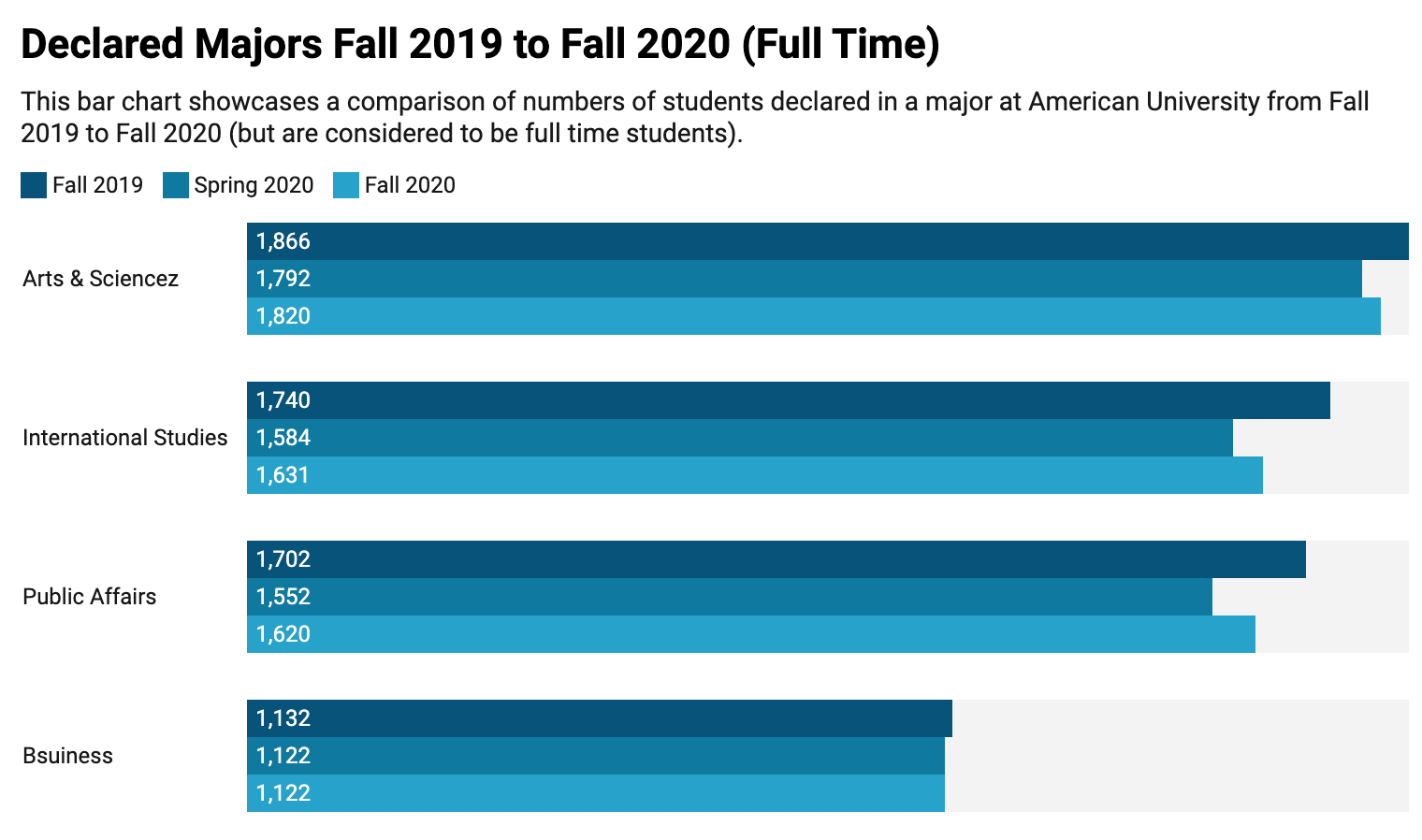
Lopez is part of the School of Communications, and in the Fall of 2020 (for full-time enrollment), the School of Communications was the fifth out of six majors to have the most full-time students in its school. They had 859 students enrolled in the school during Fall 2020, and that made up to 12% of the overall data collected for all majors.
Lopez thought about being a part-time student during the Fall 2020 semester, but eventually dismissed the idea due to it not benefiting their academic plan of graduating on-time. The way their classes were set up, and the structure of credits, Lopez thought it would be overall easier to be a full-time student and go with their degree as planned.
“I am taking 9 credits [for the Fall 2020 semester],” Madi Bendeck, an American University junior student, said. “And I am majoring in economics with a minor in political science.”
Bendeck attended American University online during the Fall 2020 semester as a part-time student. Bendeck joins 7,098 other students who attended their Fall 2020 semester part-time.
“Affordability [was a big reason for going part-time],” Bendeck said. “The fact that I can graduate sorta on-time while being a part-time [student is nice]. So I saved over $10,000 per semester by, not only staying home, but also being a part-time student.”
Both Lopez and Bendeck hope to return to American University in person as full-time students next Fall (Fall 2021) to complete their senior years with in-person class.
International Students
“At American University, at least in the freshman class, is typically six-to-seven percent international [students],” Akman said.
Though for most countries, the rate of international students who enrolled at American University went down, but students who were from China actually went up in enrollment numbers.
For both Fall 2019 and Fall 2020, enrollment numbers for international students from China have been the number one spot of most enrolled from a singular country. In 2019, 421 students who were international and enrolled at American University were from China. That number went up by 133% (an additional 143 students) enrolled at American University from China in the Fall 2020 semester.
It should also be pointed out that 27 students enrolled at American University, from Yemen, for their Bachelor’s degree, but for the Fall 2020 semester, no student from Yemen continued that enrollment.
For the country of Panama, the country became the second international place where most students were enrolling to American University over seas. Though their number of enrolled students went from 22 to 21 students, they moved up from the fourth spot to the second spot right behind China of most students enrolled from an exact country.
Looking into the future, Akman describes the lessons that were learned as a university in the case that another global pandemic happens.
“Being flexible, as an office and as a university more broadly, we have accepted being confronted with uncertainty,” Akman said. “Giving that uncertainty, we had to be more creative. We have had to think about trade-offs. Benefiting at one area at the expense of another.”
Full enrollment numbers for Fall 2021 will be coming out in the near future according to the American University Office of Enrollment.