The relationship between mass-shootings and suicides
As high-profile mass shootings have increased in frequency over the past twenty-five years, a pattern has emerged in those who carry out these attacks. Most often the attacker is revealed to usually be middle-class, White, and male. Whether it be Stephen Paddock, Adam Lanza, or James Holmes they all share these characteristics. Similarly, in America, suicides are disproportionately carried out by members of the exact same gender, race, and economic backgrounds. Using data compiled by The Violence Project on Mass Shootings as well as the CDC’s suicide data revealed that half of all mass shooters were White males and that suicides make up for a third of White male deaths. The parallels in statistical groups are not just in gender and race, shootings and suicides are both correlated to be committed in middle-class areas by middle-class perpetrators. This article seeks to show overlapping similarities between incidents, not to make generalized statements about racial groups nor is it to prove a direct connection between identity characteristics and these acts. Suicide data from the CDC shows an overwhelming majority of suicide victims are male as well as White. These characteristics are similar to those of mass shooters as data from The Violence Project revealed. According to the data provided, ninety-eight percent of mass shooters were male, and over half were White. These statistics alone do not reveal direct causation, just a correlation between White males and these acts. This still leaves a question to be answered, why? White males are statistically the most economically and socially privileged in this country, yet they are one of the most likely to commit acts of self-destruction or mass killing. Part of it certainly has to do with population, Whites make up the largest racial population in the country so there is a certain sense to their statistical dominance. Still, amongst men, Whites make up the greatest percentage of suicides per 100,000 behind Native Americans, Blacks and Asians follow.

Correlations Between Suicide and Mass Shootings
Suicide and mass shootings have more than these basic race and gender statistical similarities. Mass Shooters also have a direct connection with suicide as many shooters either kill themselves during the act or had previously been suicidal. The Violence Project revealed that nearly three-quarters of mass shooters fell into either of these two categories. Thirty percent were previously suicidal, and forty percent intended to die during the act. Again, half of these male mass shooters were White showing another correlation between the two acts and racial groups. Another correlation between suicide and mass shootings is the weapon of choice, firearms. Firearms are used in all mass shootings, however, their prevalence as a suicide method is worth mentioning. CDC data shows that White males were seven times more likely than females of any race to commit suicide by firearm. Comparing all suicides to White male suicides within the same age range, also showed that White men killed themselves with firearms double the amount of the national average. Arielle Geismar is a youth gun violence activist whose work has intersected both mass shootings, and suicide. She has worked as a National Organizing Fellow for Team Enough of the Brady Campaign United Against Gun Violence. I asked her why the profile of mass shooters was so skewed towards White males. “The profile of the mass shooter typically is a White male. Often, he is ostracized in some form either socially or neglected by his parents. This is strange however because statistically White males are some of the most catered to especially within a school environment.” Speaking on why White men commit suicide at a disproportionate rate she had this to say. “I can’t speak to the exact reason it’s disproportionate, but I do know that most Veteran and White rural male suicides are gun suicides. This may contribute to why White males commit suicide more than other groups.” Finally, I asked her why in her opinion both issues were overly prevalent for White men. “I think it has to do with White male, and maybe just male temperament in this country. Men are not taught ways to reach out for emotional help, but what they are given is ample and easy access to guns. It’s terrible, but it makes some sense as to why men unequally end up turning weapons against themselves or others.”
These two types of incidents, mass-shootings, and suicides diverge categorically in terms of class. Mass shooters and the areas they occur typically follow a trend of being middle to upper class and occurring in suburban or urban areas. The Violence Project’s data showed that nearly sixty percent of shooters grew up either middle or upper class and nearly ninety percent of shootings occurred in suburban or urban areas. Speaking with Mary Dillon an intern at The Violence Project she explained that “There definitely is a correlation between mass-shootings and suburban and urban areas. My understanding is that rural areas simply having lower populations concentrations lowers the chance of mass shootings but not gun violence in general.” This shows a correlating trend between mass shootings, relative economic prosperity, and relatively dense living communities. Additionally, eighty percent of White shooters grew up either middle or upper class in comparison with only one-quarter of black shooters. Again, this percentage alone is not enough to make any definitive connection, however, it does beg a question why are so many White shooters from relatively prosperous economic backgrounds?
One of the most surprising facts revealed by the map was poorer rural states such as West Virginia, New Mexico, and Alabama, which all have high rates of gun ownership, had little to no recorded mass shootings. In contrast, the Denver county area which has a median household income of $75,000 has suffered at least five attacks alone according to The Violence Project. This data contrasts with the suicide data provided by the CDC which shows suicide rates being higher in poor White rural states like West Virginia, Alaska, and Montana. While both suicide and mass shootings are unequally committed by White males, the reason their correlation diverges on socio-economic status may have to do with the intent and circumstances of these actions. This article is not intended to show that suicide and mass shootings are interconnected as acts, rather it is to show the statistical anomalies present within both groups that correlate.
A Common Class
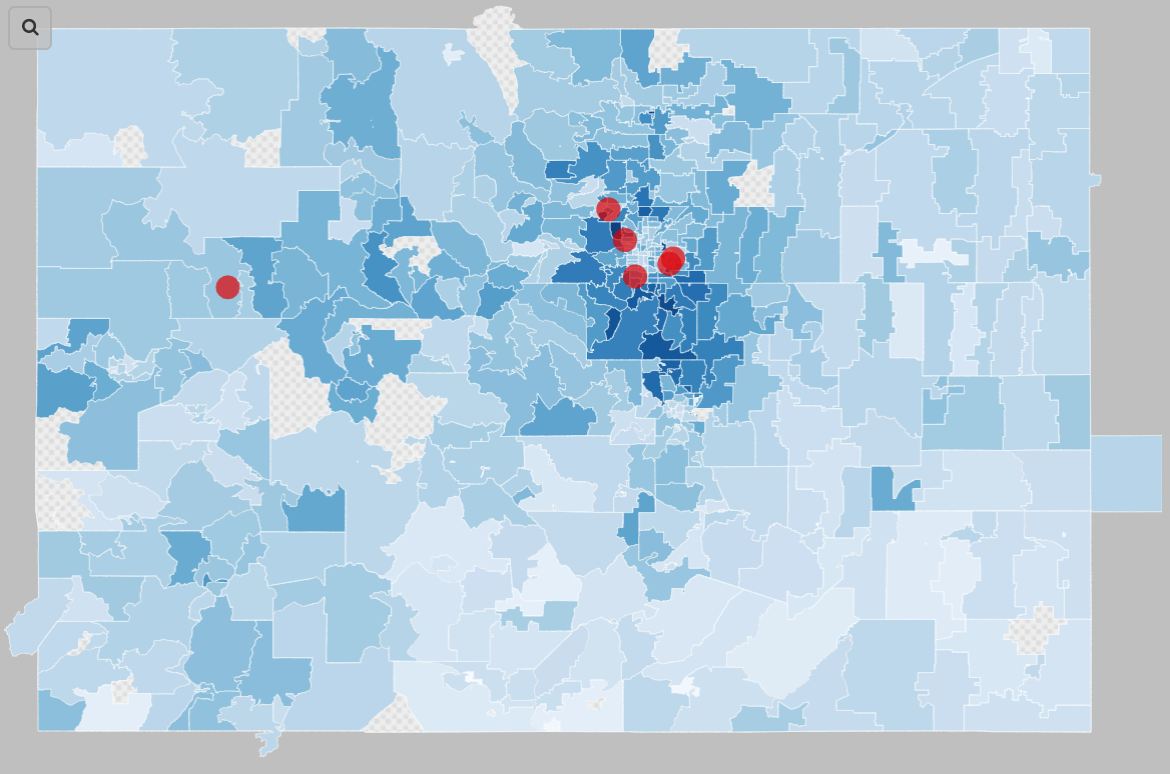
This map compares every mass shooting in Colorado with the median household income of each zip code. Every shooting location within Colorado had a higher than average median income when in comparison to the rest of the country. Only two Colorado shootings took place in an area with a median income lower than the national median of $65,000. Both attacks happened in Aurora, with median incomes coming close to $60,000. Additionally, neither attacker was from the area according to the data collected by The Violence Project. Looking further, the surrounding zip codes around Aurora have far higher median incomes than the national average. The most recent shooting in Boulder Colorado which took the lives of ten people, occurred in a zip code with a median income of $90,000 a year, close to one and a half times the national average. Additionally, the locations of the Columbine Shooting, Arvada, and Boulder all border zip codes with a median income of over $100,000. Within the context of Colorado, this shows not only a correlation between mass shootings and suburban areas but also with higher levels of wealth.
While this map shows basic statistics of the area, Google Street View can give us a more accurate picture of the areas these types of attacks take place.
This Google Street View shows a cul-de-sac less than a five-minute walk away from Columbine High School in Littleton Colorado. The street view of the neighborhoods around Columbine as well as a birds-eye view in Google Maps reveals that the area surrounding the high school is home to a manicured golf course, aquarium, mall, and amusement park. According to census data, the median income of Columbine’s zip code is $83,000, close to one and a half times more than the national average of $65,000. Just a thirty-minute drive away, the Aurora Theatre tells a similar socio-economic story.
A Google Street View of a cul-de-sac next to the Aurora Theatre.
The median income for the Aurora Theatre zip code is $56,000 dollars. This is lower than Colorado and the national median, however, this shooting differs from Columbine as the shooter was not raised in the area. The Violence Project records the shooter, James Holmes, as coming from a middle-class background.According to the BBC he was Ph.D. student in neuroscience at the University of Colorado, an institution with a yearly tuition cost of $35,000.
These specific shootings speak to the statistical anomaly seen in Colorado, as well as the rest of the US. The tendency for shooters to be middle or upper class and attack middle-class areas. The fact that most of the Colorado shooters have been White, sparing the most recent shooting in Boulder, is less significant in a nearly seventy percent White state. However, the rates of shootings in Colorado stand out more when comparing them to poorer more diverse states with similar populations. Colorado and Alabama have similar population demographics of having about five million people, as well as both, having a nearly seventy percent White population. Alabama and Colorado also share similar geographic proportions of rural, urban, and suburban populations. Where they differ is in income and amount of mass shootings. As stated previously Colorado has endured seven mass shootings in the past twenty-five years, in that same time, Alabama has had one. Despite having a higher level of gun ownership, Alabama has seen far fewer mass shootings.
These correlations reveal a trend in the US between White, middle-class, males and these two events. While suicide and mass shootings themselves as acts are not directly correlated, they share statistical similarities in gender and race. The further finding of mass shootings being correlated to higher levels of wealth creates more questions than it answers. The rates of suicide being higher in lower class, rural areas make relative sense, what does not is the connection between relative prosperity and mass shootings. As our nation comes out of the Coronavirus pandemic, the re-opening of America has already come with an increase in gun violence and mass-shootings. As it continues, additional measures will need to be put in place, not only to curve gun violence at large, a monumental task but also to address where and why they are happening. Mental health and other pre-determining factors are issues I have not even discussed in this piece, and most certainly should be addressed to reduce violent acts such as mass shootings and suicide. Still, curbing gun accessibility and increasing mental health services will not answer the question of why these high-profile shootings occur in middle-class America.