Evanston's reparations program falls short of community needs
Lesley Williams could not stop thinking about her father in the days after March 22, when the city of Evanston, Illinois passed the nation’s first reparations program. She racked her mind — ‘what would he have to say about this?’
He had faced a lifetime of injustice. When he transferred to Northwestern University, he wasn’t allowed to live in the dorms but rather find housing with a local Black family. Williams, a Black resident of Evanston for over 25 years, was raised in a Chicago bungalow on Michigan and 91st. Redlining maps described her childhood neighborhood as “a good neighborhood from a negro standpoint.”
“Even if my father was still alive, there’s no way that this could actually make up for everything that happened to him and everything that happened to all the other Black people in American history,” Williams said.
Like Williams, residents and others have weighed in — the reparations program set into motion by the city council falls short, undermining past and present racial disparities in the city and presenting an ineffective solution to a long-lasting problem.
Reality
Disparities faced by Black residents in Evanston are widespread and extend far beyond the effects of discriminatory housing policies that the city has centralized on with its reparations program.
While the city’s decade-long reparations program begins to unfold, what does this mean for Black residents that face other types of racial discrimination? What about residents who don’t qualify for reparations?
Looking at other factors that historically and presently harm marginalized communities, it was found that Black residents in Evanston are disproportionately arrested and policed. Black students are also disproportionately punished compared to their white peers.
Evanston’s population totals around 74,000 residents. Of that number, 67 percent are white, and 17 percent are Black. Despite being in the minority, Black people make up the majority of arrests recorded by the Evanston Police Department. In fact, a Black person is seven times more likely to be arrested than a white person in the city.

Note: Hispanic residents are included in the white category. Evanston Police Department’s data does not reflect an accurate distinction between the two. Of the 67 percent, 60 percent are white-alone, and the remaining identify as Hispanic or Latinx.
These inequalities were found to leak into police activity as well. The segregated boundaries enforced by the city’s discriminatory policies in the mid-twentieth century remain today.
Traffic stop violations recorded by the Evanston Police Department show that neighborhoods with a larger Black population are more heavily policed and ticketed.
As the map displays, police activity in these neighborhoods was more likely to be internal, meaning that police were active within neighborhood streets rather than on bordering, busy roads — a trend shown in areas with larger white populations.
According to Williams, policing has long been an issue disproportionately affecting Evanston’s Black community. In October 2015, Lawrence Crosby, a graduate student at Northwestern University, was beaten by police after a passerby mistook him for stealing the car he owned.
“If you really wanted to show that you cared about African American residents, you might consider defunding the police and using some of that money to support African American communities,” Williams said.
In addition to policing, data from Evanston Township High School’s Board of Education, the city’s only public high school, shows discrepancies between the disciplinary treatment of Black and white students.
Systematic discrimination has historically plagued the U.S., and Evanston is not to spare. On top of housing, policing and education are two issues among the many others that culminate to form the lived experience for Black Americans everywhere.
About the Program
The Local Reparations Restorative Housing Program won in an 8-1 vote by council members. The program’s overarching goal is to address the wealth and opportunity gaps experienced by Black residents.
“The Restorative Housing Program is the first initiative developed by the Reparations Subcommittee focused on preserving, stabilizing, and increasing homeownership, which builds intergenerational wealth among Black/African-American residents,” said members of the reparations subcommittee in their March 22 memorandum.
The city has pledged to distribute the first $10 million generated by a 3 percent sales tax on recreational marijuana to qualifying residents. In the current stage of the program, $400,000 will be distributed to sixteen households to be used toward down payments and home repairs.
To qualify for the program, Black community members of African descent must prove that they were residents or related to residents of the city between 1919 and 1969, the timeframe in which Evanston actively enacted discriminatory housing policies.
According to Williams, opposition to the program began at town hall meetings where residents had conflicting ideas of what reparations should look like.
“It became clear I think that those divisions were really deepening,” Williams said. “There was the sense that the group that doesn’t believe in direct payments was being listened to more than those that do believe in direct payments.”
The singular dissenting vote came from Cicely Fleming, the ninth ward alderwoman and one of three Black council members. Fleming said she is “100% in support of reparations” in a statement she gave to the rest of the council following the March 22 vote. However, these are not reparations — to Fleming, they are “a housing plan dressed up as reparations.”
“We must understand the definition of true reparations and its main goal: to do that, the People dictate its terms to Power, not the other way around,” Fleming said in her statement. “Rather, this resolution is dictating to Black residents what they need and how they will receive what they need.”
Williams echoed this sentiment. She added that the two biggest actors responsible for harming Evanston’s Black community, the banking and real estate industries, are the ones who will be rewarded with the $25,000 eligible recipients will receive.
“It would be one thing not to charge any of these people fees or closing costs to acknowledge that they were complicit in this; that would be different,” Williams said. “But to just say we’re giving you money that you then have to spend on the two organizations that are responsible for impoverishing you in the first place makes absolutely no sense.”
History
Aldermen concluded that the strongest case for reparations lay in the realm of housing after the council was presented with evidence demonstrating disproportionate harm to Black residents from city zoning ordinances.
Michael Bader, Associate Professor of Sociology and Policy at American University, specializes in studying patterns of racial change in cities and neighborhoods. According to Bader, there is benefit to focusing on housing.
“There’s an intergenerational transmission that if we invest in neighborhoods and invest in housing and improving neighborhood school conditions, we can eventually have benefits not only for the current generation to enjoy them but also for their kids,” Bader said.
Dino Robinson, Executive Director Shorefront Legacy Center, and Jenny Thompson, Director of Education at the Evanston History Center, presented their report, “Evanston Policies and Practices Directly Affecting the African American Community, 1900 - 1960 (and Present)” in August.
“Since its platting, the city of Evanston both supported and created systems to segregate, limit, deny, and control Black citizens,” said Robinson and Thompson in their report.
The report outlined the combined efforts of Evanston’s banks, builders, realtors and government that limited Black mobility and livelihood.
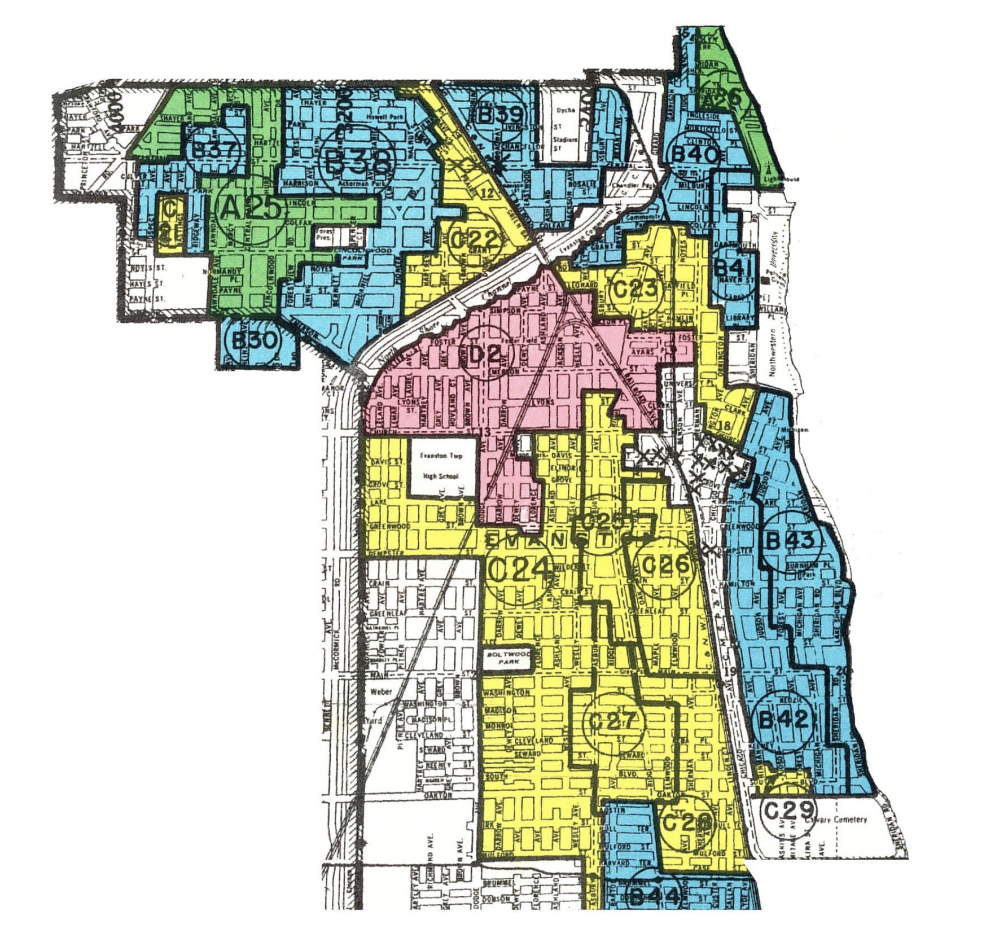
Into the 1940s, the Home Owners’ Loan Corporation prepared a map evaluating the risk of making mortgage loans in different Evanston neighborhoods. A triangular area north of Church Street and bordered by the North Shore Channel was home to the city’s largest Black population. The same area was given a grade of “D” and shaded red – indicating ‘”undesirable population or an infiltration of it,”’ according to HOLC.
The same segregated boundaries present in the 1940s appear today.
The report also made clear that issues of housing were not the only things hurting Black residents, though they were most clearly compounded by the city.
Looking Forward
In the coming decade, the remaining millions of dollars will be distributed to Evanston’s Black residents through reparations to restore the damage done by housing practices.
In the meantime, Black residents will likely continue to face persistent discrimination through systems such as housing, policing and education that have sustained this harmful, racist pattern.
Residents like Williams have taken the initiative into their own hands. Williams’ synagogue, Tzedek Chicago, is working to implement its own reparations program for other congregants to pay into.
“The synagogue is working on how to make an actual commitment and not seeing it as a charitable donation but actually using it as a tax which I think is important,” Williams said.
Though Evanston was the first city to issue reparations to its residents, it might not be the last. For some, this is a point of pride, and for others, it’s troubling.
“This isn’t change that can be a beacon for the nation,” Fleming said in her statement. “It is a dim, weak light. And it will be a travesty for Black communities around the U.S. if it becomes our model going forward.”
Bader believes that this initiative is a first step toward equality, but there needs to be something more expansive to make amends.
“The scale of the problem is just much bigger than Evanston,” Bader said. “It really needs to be handled at a federal level.”
Bader continued, “It’s not just a drop in the bucket; it’s a drop in the ocean.”