Homeless Vermonters still struggle to find affordable housing
“I think I pay close to 50% of my income for my housing. As a single parent, even for me, that’s hard. 50% of my income goes right to my rent, and that doesn’t include anything. Is that affordable?”
Martina Newell has never been homeless before, but she knows that if she were to suddenly lose her job, housing insecurity might not follow far behind. She is also the direct services manager at Samaritan House, a nonprofit dedicated to fighting homelessness and supporting homeless people in the town of St. Albans and the surrounding county – in other words, she is not much different from the people she tries to help.
Her direct work with her clients and her personal experience have shown her that contrary to the popular image of homelessness, which is often defined by extreme poverty and a housed versus not housed dichotomy, anyone can be in danger of losing their home. “There’s increasingly an amount of people that are living paycheck to paycheck, making really good wages, but have a traumatic life event,” she says, which leaves them without a place to live.
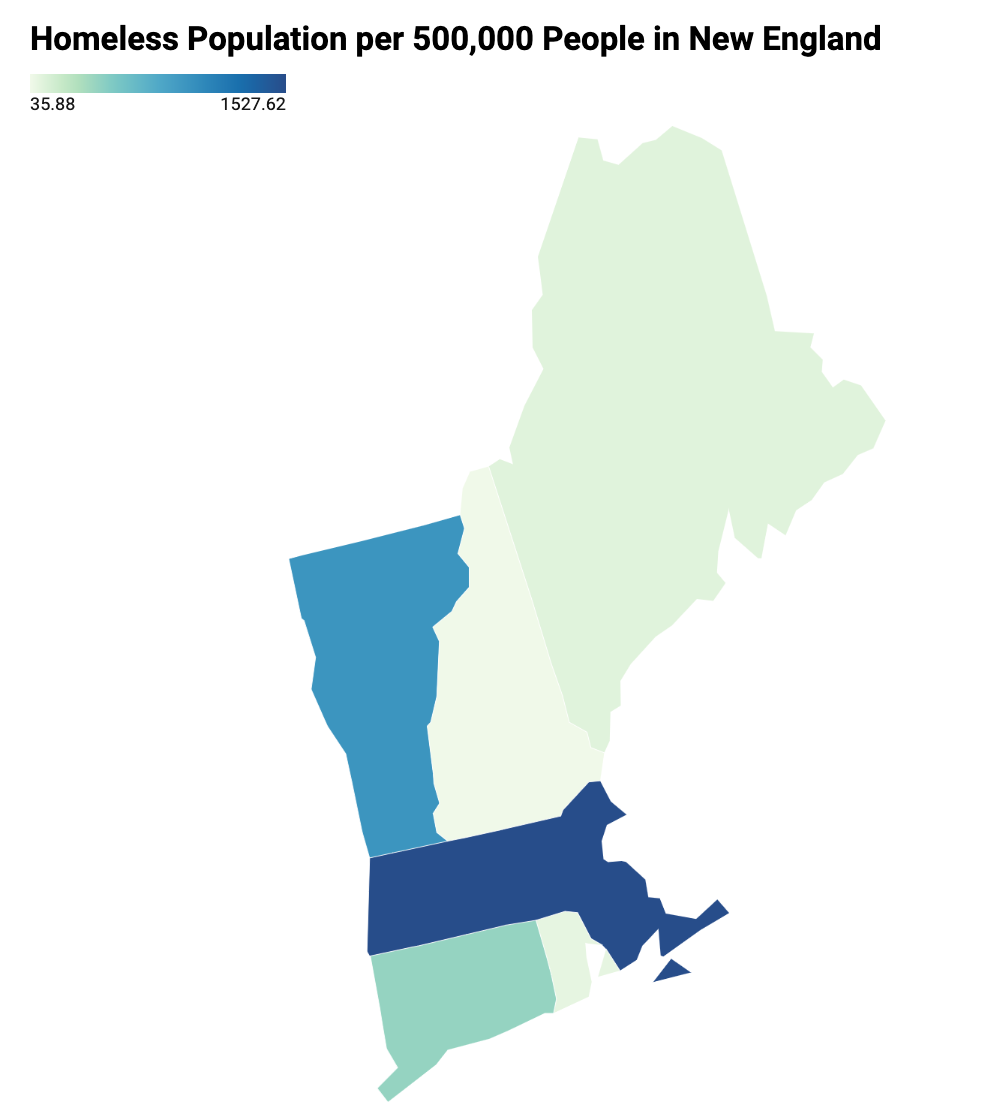
Compared to other states in the US’s New England region, Vermont has the second highest amount of homeless people per capita, second only to the much more urban Massachusetts.
Before the COVID-19 pandemic, the vacancy rate for affordable housing in Vermont ranged from 0.5% to 2%. When the pandemic started spreading into the state, many agencies’ congregate shelters had to close. To compensate for this, the Vermont General Assistance program, which normally has stricter regulations on eligibility for homeless status based on those used by the US Department of Housing and Urban Development – petitioners cannot have caused their own homelessness or be doubled up with other households, for example – loosened its requirements and started relocating homeless individuals and families to hotels. The main problem for the state is moving these people out of hotels when there are next to no affordable houses for them to move into.
“Vermont is a very expensive place to live in,” Newell says. In fact, Vermont has a higher overall cost of living than many other US states.
Many homeless people in Vermont find themselves traveling to its southeasternmost county, near the town of Brattleboro. Libby Bennett, who works with the Brattleboro-based homelessness support nonprofit Groundworks Collaborative, says, “People who are homeless in other parts of the state are, for lack of a better word, being sent here by the state.” While their case managers in other parts of the state are communicating with them through phone or video calls, Groundworks does its best to assist them in the Brattleboro area.
The model Groundworks and other Vermont nonprofits use is one they call the “three-legged stool” of subsidies, support, and brick-and-mortar housing. Governor Phil Scott has recently allocated $249 million to affordable housing and homelessness prevention in the state, and Groundworks has doubled the size of its case management team from 5 to 10 people since the COVID-19 pandemic started. Bennett believes that physical housing units are the one leg missing from the state’s efforts. “In Vermont, the resources for the three legs never roll out together,” she says. Vermont’s low vacancy rates for affordable housing have changed little over the past year, and the coronavirus has only placed further pressure and given further visibility to an already strained system. Bennett says, “It was always an extreme situation.”
Vermont’s heavily rural demographics differentiate the state’s homelessness problem from those in more urban areas, and nowhere is this clearer than in its Northeast Kingdom region, comprised of Essex, Orleans, and Caledonia Counties. The latter two are the counties with the highest number of total COVID-19 cases since the start of the pandemic.
Before COVID-19, it was not uncommon for people to move in with other households, according to Jenna O’Farrell, executive director of Northeast Kingdom Community Action. “Especially in the Northeast Kingdom, I think people are pretty resourceful and would stay with relatives, and maybe in unsafe situations,” she says, “but they maybe didn’t meet the HUD standards for homelessness because they were doubled up.”
O’Farrell also believes that the state has struggled to accurately assess its own housing needs in its yearly point-in-time homelessness count. Vermont makes its count in January, when many people are going out of their way to find places to live in the winter. “If you did the point-in-time count in July, when you literally do have homeless folks out on the street in downtown areas, your count would be much different. But doing the homelessness count on a 10-below night in January is not going to get us accurate data,” she says.
O’Farrell describes individual communities’ populations of homeless people as “right-sized to the demographics,” regardless of how rural or urban they are, citing the more urban Chittenden County with its higher homeless population as an example. She adds, “Local communities come up with local solutions to meet that number.”
Newell says that the root of homelessness can often be persistent; Vermonters raised in state-sponsored housing as children may struggle to find a livable wage as adults and find themselves in the same situation as before. In her opinion, generational problems require lasting, generational solutions, ones that go beyond the expenditure of state money on the right causes and focus on strong, mutually supportive communities. “Yeah, you can build all these affordable houses, but you need people in these positions to make sure that they’re continuing on,” she says. “It’s not like you can say, ‘We’ll put them in here, and then they’re good.’”