Poverty rates combined with Covid-19 caused learning loss in Virginia in 2020
Justice High School’s Advancement Via Individual Determination (AVID) college-readiness program for typically first generation, traditionally underrepresented students who are college-bound is the lifeline for many to attain their dream of being the first in their families to go to college. “As many as 12 million students nationwide have lacked access to internet, devices, or both. Data show that learning loss has been severe and has the potential to affect a generation of students,” said Kenneth Polishchuk, Senior Director of Congressional and Federal Relations at the American Psychological Association (APA) in Washington, DC. High school dropout rates increased significantly in several Virginia school divisions with lower than average median income, including Buena Vista County schools which saw the dropout rate increase from 4.5% in 2019 to 13.43% in 2020. Manassas City, Virginia which already had a high dropout rate of 8.7%, saw its dropout rate increase to 10%.
Virginia educators know first-hand the value of AVID, and other programs such as the Early Identification Program (EIP) sponsored by George Mason University, the Department of Rehabilitative Services (DARS) program which focuses on career and job opportunities, and the Postsecondary Education Rehabilitation Transition (PERT) Program that help students overcome adversity and achieve educationally. Educators agree that early interventions in schools are needed to help marginalized students reach a higher level of educational attainment in Virginia, including underrepresented populations and persons with disabilities.
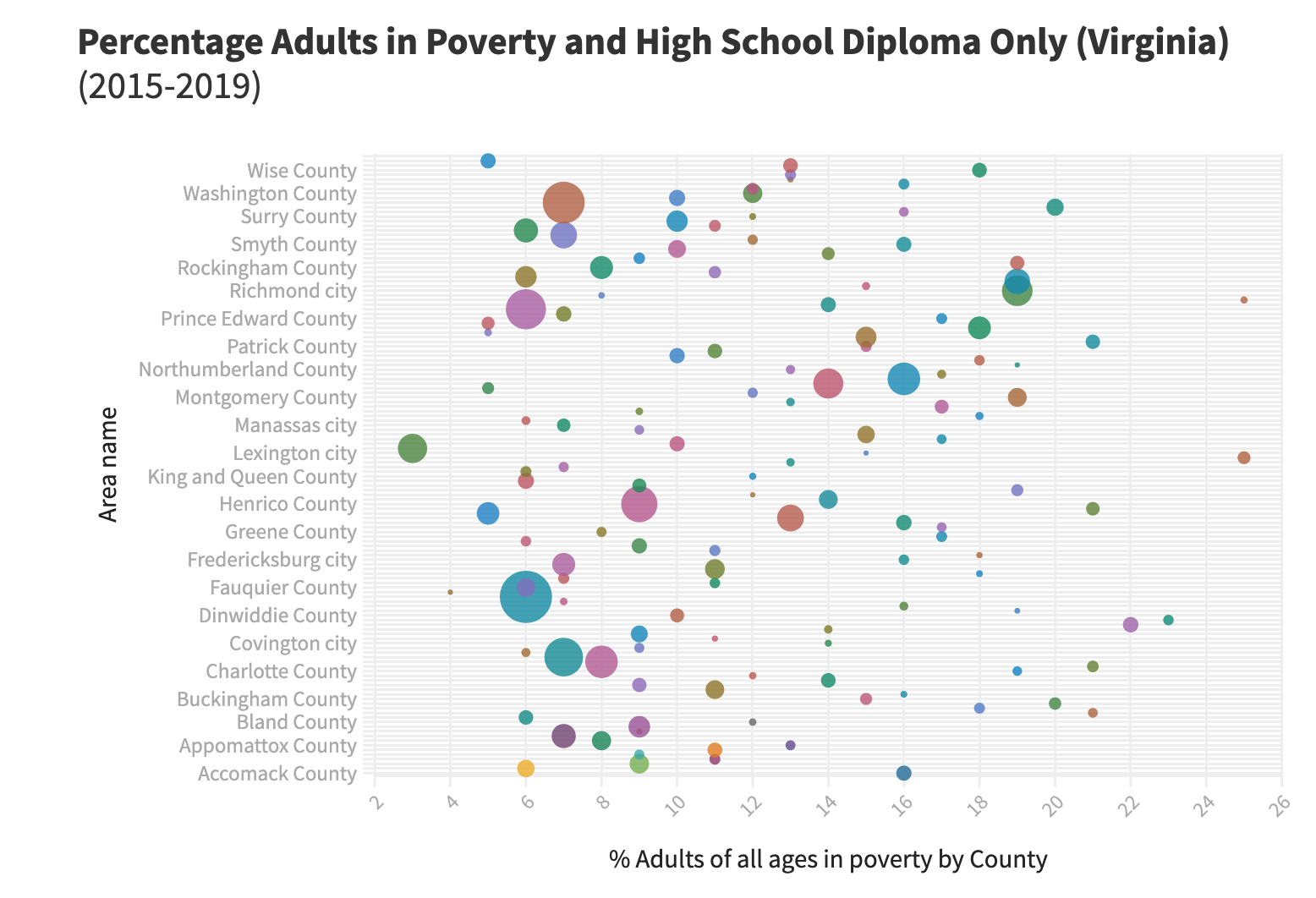
While Virginia’s poverty rate was 9.9% in 2019, of the 95 counties and 38 incorporated cities considered county-equivalents for census purposes, over 60% had rates higher than the state poverty rate. Ten areas had a poverty rate more than 20%. Middle schools and high schools have adopted a variety of strategies and programs to help at-risk students, such as AVID, EIP, and others to improve the number of students graduating high school and preparing them to be successful after high school. This includes teaching skills and coaching many first-generation students toward enrolling and graduating from college. Learning these skills comes in many forms, like the hydroponics class at George Mason High School in Falls Church, Virginia.
“I think it is important that we not look to blame the home environment or the parents as the cause of students living in poverty. Instead, we should focus on things that we can change, most importantly providing quality schools that encourage and value post-secondary options for all students”, said Jamie Lahy, special education teacher at Sarah Dooley Center for Autism in Richmond, Virginia. “My hydroponics and aquaculture programs at George Mason High School were recognized by the Environment Protection Agency (EPA) in 2017.” Lahy’s hands-on program helped students prepare for college, while at the same time providing real world solutions to the problem of food deserts.” Lee, Tazewell, Buchanan, and Dickenson County all have poverty rates that match up with their lower rates of household median income. The wealthier counties of Fairfax, Falls Church City, Virginia Beach, Loudoun, and Arlington all have household median income levels greater than $100,000.
Educators agree that the current system of Virginia’s education curriculum focuses most of its resources on providing AP courses in high school for college-bound students, leaving out many students who lack the support at school and home to overcome obstacles and graduate prepared for the workforce. “Every student can learn, but not at the same time and in the same way. I wish the public better understood that by helping students when they are younger, we will actually see an economic benefit as a country. These students are smart and hardworking, but they lack mentors and hope,” said Fairfax County Public School (FCPS) AVID instructor, Terri Markwart, of McLean, Virginia. “They also don’t have thousands of dollars for tutors or test prep. There is a huge connection between poverty and educational attainment.”
Almost 50% of funding for public education in the United States is tied to local property taxes. (ASCD, 2002) This typically means that wealthier, affluent communities will have well-funded public schools that provide their children with a quality education, which includes a variety of support systems and activities that generally ensure a safe, supportive school environment.
Communities that do not have the local funds to support their school systems, must turn to state and federal funding to help close these gaps. These communities tend to be lower income and often communities of color. Counties with the lowest poverty levels, ex. Fairfax County, correlates with higher levels of high school graduates. While “COVID-19 has further exacerbated all these educational disparities, shining a bright light on the pervasive, systemic inequities in the entire system. Remote learning has not been a panacea. Learning over the past year has been extremely challenging for all students, but particularly those who are low-income and living in urban, rural, and tribal communities, where there are significant disparities in access,” said Polishchuk.
As Virginia schools reopen and begin to recovery from the impacts of COVID-19, state and local leaders will have to make hard choices, including exploring increasing local property taxes to fund early intervention programs for at-risk students and digging deep into state coffers to help students get back on track and make up for the year they spent in remote learning and away from in-person classroom learning.
#References:
http://www.ascd.org/publications/educational-leadership/may02/vol59/num08/Unequal-School-Funding-in-the-United-States.aspx
https://www.usnews.com/education/blogs/high-school-notes/2015/02/09/3-answers-for-high-school-parents-about-avid-classes#:~:text=AVID%2C%20which%20stands%20for%20Advancement,teamwork%2C%20organization%20and%20reading%20skills.
https://www.census.gov/data/datasets/time-series/demo/popest/2010s-counties-total.html
https://www.ers.usda.gov/data-products/county-level-data-sets/download-data/
https://p1pe.doe.virginia.gov/apex/f?p=246:1:::::p_session_id,p_application_name:-7720804716622119558,cohortgrad