Large Gaps Between Medicare Spending and Enrollment May Prompt Changes in the System
Certain regions in the United States adhere to the trend that the spending rate on Medicare is higher than the enrollment rate. On average, Midwestern states have the largest gap between how much is spent on Medicare and how many people are enrolling in the program. In contrast, Southern states on average have the smallest gap between money spent on Medicare and amount of enrollees.
Medicare is a government program that provides health insurance for Americans aged 65 years and older. These individuals receive the benefits of Medicare through paying taxes into the system as they work. Depending on their plan, recipients have to pay a monthly premium as well as a copay for services received. The amount of money recipients have to pay for these services depends on a variety of factors, including those specific to region.
“Health care in Nevada is different than health care in Washington D.C.,” said Deputy Assistant Secretary in the Federal Housing Administration Office of Health Care, Roger Lukoff.
Sue Keating, a Medicare recipient, experienced these differences when she moved from Mississippi to Las Vegas. Under her plan in Mississippi, Keating said she would have had an expensive copay for her hip replacement, but in Las Vegas, she didn’t pay anything for the procedure.
“They [hospital bills] are thousands of dollars that we don’t have,” Keating, who receives Medicare services through United Healthcare with the American Association of Retired Persons, said. “We’re completely satisfied with what we got.”
Las Vegas, located in Clark County, has some of the best health plans, according to a United Healthcare sales associate. With United Healthcare, different states have different plans due to these regional differences.
Although some of these differences are paid by the Medicare recipients through their premiums and copays, the bulk of the bill is paid for by Medicare and insurance companies. “I’m very fortunate right now that I don’t have to pay when I go for procedures. Medicare covers a lot and whatever they don’t cover, my insurance company handles,” said Maryann Tydryszewski, a Medicare recipient in New Jersey.
The majority of Midwestern states have the largest gap between enrollee rates and Medicare spending rates. Out of this region, South Dakota and Minnesota have the largest gaps between these two factors. Between 2013 and 2014, South Dakota’s spending on Medicare increased 6.9%, while their enrollment only increased 3%. This makes the gap between spending and enrollment about 3.7%. In Minnesota, spending on Medicare increased 6.8% and enrollment increased 2.9%. This results in a gap of 3.8%.
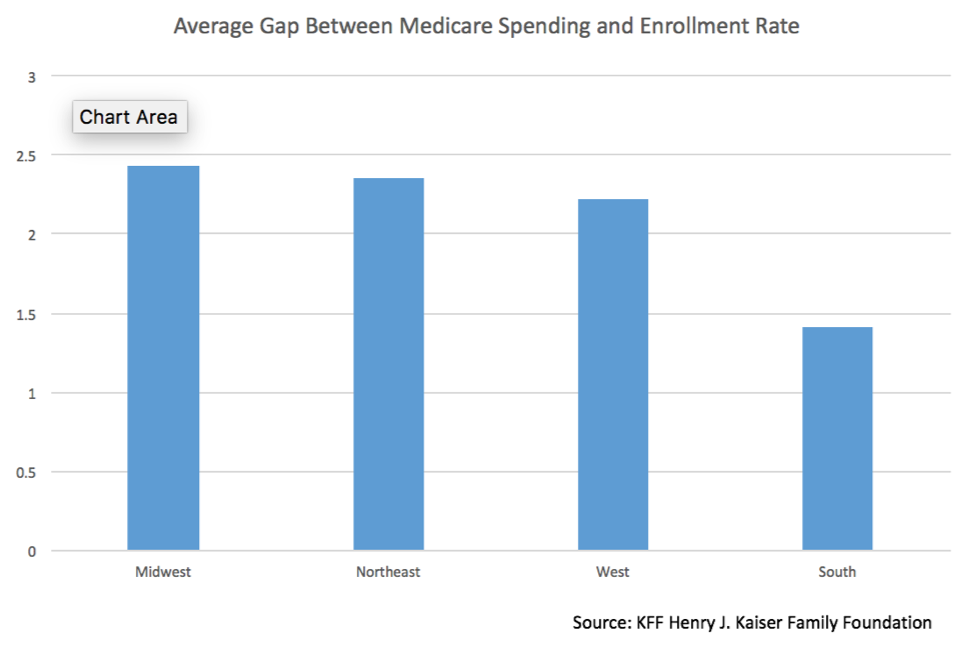
Contrasting the large gap in those Western states, the Southern region contains some of the smallest gaps between Medicare spending and enrollment numbers. Louisiana and North Carolina are the two Southern states with the smallest gap. Between 2013 and 2014, Louisiana had a 2.9% increase in total spending and a 2.8% increase in enrollment, leaving them with the smallest gap, 0.1%, between spending and enrollment. North Carolina had a 3.6% increase in total spending and a 3.4% increase in enrollment, making their gap a low 0.2%.
“There may be multiple explanations for this phenomena, including more complicated patients seeking care,” said Lukoff after observing this trend.
As the number of Medicare patients with complicated health concerns increases, there is a rise in the number of expensive treatments. The result is the government spending more money on Medicare. This increase in spending also coincides with increased enrollment rates.
The disparities between the Southern region’s spending and enrollment compared to those of the West’s puts forth the question: what motivates these regional disparities?
“Different prices may be due to regional differences, level of care, if it’s specialty care, rural, or has less facilities,” Debbie Feierman, an employee at the Centers for Medicare and Medicaid Services, said.
One of the factors that influences regional differences is the amount of specialized facilities in different states, according to Lukoff. Medicare recipients that require uncommon procedures often have to go to states with specialized health centers and medical schools to receive treatment. Because these services are expensive, Medicare pays more money in those states per capita.
Most of these specialized health care centers and medical schools are located on the East coast. New York and Philadelphia, specifically, are known for their expensive health care, according to Lukoff.
Other factors for the increase in Medicare spending include a growing Medicare population as baby boomers age and their increase in life expectancy, according to State Senator Valerie Wiener (Retired) of Nevada, who is now a medicare recipient herself.
Increasing costs of healthcare have been in the political conversation as they are expected to rise to almost 20% of the GDP by 2026, according to a CMS report.
“We don’t have a budget. In our country we don’t know how much we spent until the year’s over, well after the year’s over,” Lukoff said. “That’s why our costs are almost 20%. Congress likes to say yes to almost as many things as they can.”
As healthcare consumes more of the country’s spending, other government services, such as education, are facing cutbacks, according to Wiener.
“Where is the tipping point where medicare is depleting other services enough were we have to have the hard conversation about revitalizing the system?” Wiener said.
As the cost of healthcare continuously grows in the US, there’s been discussions about moving the age of eligibility for Medicare up from 65 to 67. This has been met with opposition from current and soon-to-be Medicare recipients.
“There’s two things old people do. They vote, and they love Medicare,” Lukoff said. The high turn out rate for the group of 65 makes Medicare a top priority for politicians to consider.
Keating acknowledged fears amongst her peers that Medicare will run out of funds. “If we didn’t have Medicare, we wouldn’t seek treatment.”
There remains a tension between the increasing cost of healthcare for the government and the desires of the people to keep Medicare.
“I have enough bills to pay and I don’t have to worry about health coverage, people who don’t have this neglect to go to the doctors and don’t get medicine,” Tydryszewski said, “I feel bad for those people that aren’t covered.”