The Pipeline from Honduras to New Orleans
“Baleadas are the best. Puro catracho.”
A middle-aged woman switches rapidly between English and Spanish, starting to explain the intricacies of cooking a baleada over the phone. She stops in the middle. “You get the point.” Her name is Patricia Flores and she belongs to the Honduran community in New Orleans, working intricately with the community as a volunteer with the New Orleans Hispanic Heritage Foundation. “You know, the baleadas in New Orleans aren’t bad. Not like in La Ceiba or anything. But not bad.”
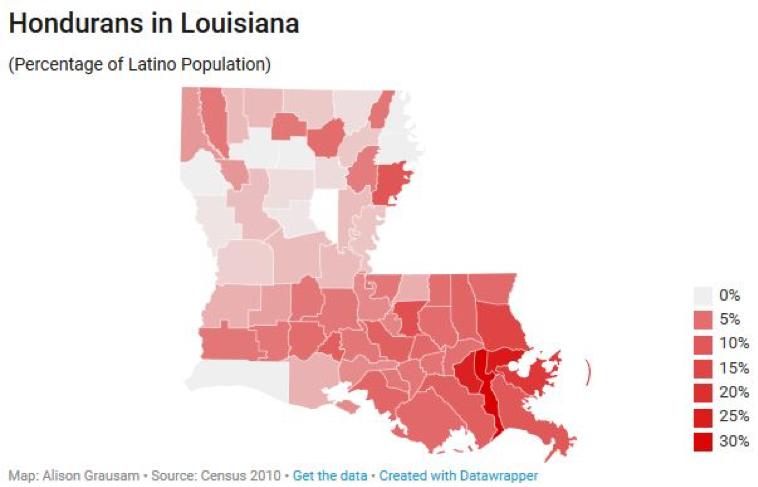
There’s a reason she is directly comparing her family’s homeland of Honduras and her hometown of New Orleans. The city’s community of Honduran immigrants is the highest in the nation, when counting by percentage of the Latino population. Almost 16 percent of the Latinos in New Orleans identify as Honduran. While the community may be spread out across the nation, there is certainly a focal point in the state of Louisiana.
How did this happen? An explanation from Carlos Alcerro Torres, a clerk at the Embassy of Honduras, reveals that there is a deep connection between Honduras and New Orleans.
“A lot of people don’t know this – I don’t know if they teach it much – but there’s a long history between the US and Honduras,” he begins. The connection is based off of two large fruit companies called Standard Fruit Company and United Fruit Company, which had their bananas grown in Honduras, but maintained their corporate headquarters in the United States, in New Orleans.
Initially, a number of Hondurans and their children who worked for these fruit companies immigrated for the opportunities made available through the presence of the headquarters and set up a small community. It stayed small until a coup attempt in 1959 and a successful coup in 1963 led to instability in the country and a mass exodus from Honduras to New Orleans.
Today, there are over 15,000 Hondurans living in the four parishes that make up the city of New Orleans. The population is so large that the Honduran government decided to maintain a consulate-general in the city, which is a privilege more typically reserved for much larger cities like Houston.
The actual story of the ties between the United States and Honduras through the United Fruit Company is fraught, filled with complexity.
During the heyday of the UFCO, bananas made up over 80% of the exports from Honduras, following in the tradition of Latin American countries basing their economies on raw materials. The children of UFCO workers were granted visas to come to study in the United States, often attending schools like Loyola University or Tulane University, which gave them a good opportunity to succeed upon graduation.
While some returned home, many took up permanent residence. There were also adults who immigrated on work visas sponsored by the office workers of UFCO, arriving in the country and working as live-in maids or gardeners. And yet more arrived after working their way up in UFCO while still in Honduras and earning jobs in the New Orleans headquarters.
A strong social pipeline was formed. “In Honduras,” Flores tells me, “America means New Orleans.”
Many of the Hondurans living in the city will fiercely claim identity both with other Hondurans, but also with the Central American community as a whole. Given that they share a similar cultural history, it is easy for newer immigrant populations like Guatemalans to mesh with the already existing Honduran community.
However, the difference is that while newer immigrant groups tend to be getting their feet on the ground in a new country, so to speak, much of the Honduran community in New Orleans has already established themselves. While many Latino communities are faced with low-wage jobs and lack of access to quality education, the Honduran community as a whole has already begun to jump those hurdles.
According to data provided by the Bureau of Labor Statistics, the Honduran community is, on average, earning a higher wage annually in comparison to their Latino counterparts as a whole.
In addition, it was, and still is, much easier for Honduran immigrants to assimilate to the United States in comparison to other immigrant groups.
This is according to Denese Neu, who is getting her doctorate in Urban Affairs in her hometown at University of New Orleans, saying she had a longtime interest in this community.
“I grew up with piñatas and pastel tres leches at birthday parties,” she says, explaining how she has been around the community since her childhood. She grew up in schools next to children of UFCO workers and learned about how this Honduras-New Orleans pipeline worked both ways.
It brought Honduran immigrants into the United States and it brought American culture into Honduras. Thus, when new immigrants arrived in New Orleans, they were already more comfortable and did not form the same tight-knit communities that other Latin American immigrant groups have done. This, according to Neu, has meant that the community has often struggled to keep some of their culture alive.
Flores agrees: “My generation and my parents’ generation… We have lost a lot of our culture. I am a New Orleanian first and Honduran second.” But she says that there is hope. The students she speaks to in the New Orleans Hispanic Heritage Association are taking up the mantle, she believes.
They have a renewed interest in the country of their parents and their grandparents. They are learning to dance the sique and to cook baleadas. They have always spoken Spanish, but now they are associating themselves with Honduras in more ways.
The balance is shifting, Flores believes. Even if the new generation has never lived in Honduras, they are becoming Honduran first and American second.