Remembering the Confederacy is not just for the states that were part of it
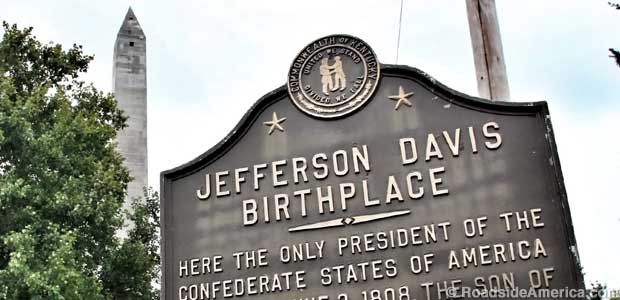
At the Jefferson Davis Historic Site in Fairview, Kentucky, stands a monument and a museum honoring the birthplace of the first – and only – president of the Confederate States of America. Photo courtesy of Roadside America.

Near the southwest corner of Kentucky, there is a Washington Monument look-alike. At 351 feet, the obelisk is the tallest structure in Fairview. When it was constructed in 1924, it was the tallest structure in Kentucky. The obelisk, which sits on a base of solid Kentucky limestone, commemorates one of the state’s most famous sons: Jefferson Davis, president of the former Confederate States of America.
In Hodgenville, a town in the heart of Kentucky, the “First Lincoln Memorial” sits honoring the birthplace of Abraham Lincoln, the 16th president of the United States of America.
With 51 confederate sites, Kentucky, perhaps better than any other state, represents the parallel histories of the United States. In 2017, border states removed three times as many confederate monuments than former union states and states that were territories during the Civil War combined.
During the Civil War, which split the country into North, South, and in-between from 1861 to 1865, Kentucky was one of five border states caught in the middle of the conflict.
Even today, people still feel the tension between northern and southern ideologies.
It is a gross oversimplification to say that everyone in the South remembers the people-owning days of the Confederacy fondly as much as it is an oversimplification to say that the northern states were unbigoted, moral beacons.
It is a fair assessment, however, to say that the War Between the States was fought over the issue of slavery. The North wanted to abolish it. The South wanted to preserve it. That is the Confederacy’s legacy.
Some say the men who fought for the Confederacy were heroes. Others call them racists and traitors. At what point does remembrance become reverence? In recent years, that point is being debated with greater ferocity after the Confederacy has been used to justify acts of violence.
In 2015, self-proclaimed white supremacist Dylann Roof killed nine African-Americans in church in Charleston, South Carolina.
In 2017, the “Unite the Right” rally in Charlottesville, Virginia resulted in the death a counter-protester and the injuries of several others when a member of the so-called alt-right drove his car into a crowd. The impetus of the “Unite the Right” rally was to protest the removal of a statue of Confederate Gen. Robert E. Lee from a park named for the same general.
The Southern Poverty Law Center released in 2016 a list of all “public symbols of the Confederacy” found in the U.S. The symbols included monuments, towns, streets and schools but excluded historical sites.
“For the final tally, the researchers excluded nearly 2,600 markers, battlefields, museums, cemeteries and other places or symbols that are largely historical in nature,” the SPLC said in their study of public Confederate symbols.
There is a total of 135 symbols in the 19 states that were not members of the Confederacy.
Confederate symbols
To be fair, this number is dwarfed in comparison to the number of public monuments to the former Confederate States of America that are densely scattered throughout the South. As of 2016, there were 1,354 symbols of the Confederacy in states that made up the Confederacy. Virginia, a former Confederate state, tops the list with 223 public Confederate symbols.
That is to be expected, especially given the majority of Civil War battles occurred in Southern states, particularly Virginia and Tennessee.
So, if these northern states, border states, and not-yet states fought against the Confederates on the Confederates’ own turf, why are Confederate monuments not confined to the battlegrounds and cities of the South?
That would only make sense on the grounds of remembering the nation’s history. After all you would not travel to Florida to remember the Alamo.
Some of these states have responded to the call to remove Confederate imagery from their cities. After the Charleston shooting, Kansas removed the Confederate battle flag from Wichita’s Veterans Park. In 2017, Baltimore removed all four of its Confederate statues overnight.
After the removals, Baltimore Mayor Catherine Pugh said, “They needed to come down. My concern is for the safety and security of our people.”
Pugh feared Charlottesville-style violence. A group of protesters had threatened to tear down the statues of Lee and Gen. Thomas “Stonewall” Jackson themselves if action was not taken by the city.
A number of Confederate symbols were established by state and local governments. Two cities in California – Fort Bragg and Confederate Corners – are named for Confederate veterans despite California being Union state that never saw a Civil War battle.
From 1868 to the middle of the 1930s, Confederate monuments and memorials were going up on an almost yearly basis in Non-confederate states, the vast majority in Kentucky.
Half of the monuments standing in Non-confederate states today were erected before 1920.
During the fifty year period between 1868 and 1918, the United Daughters of the Confederacy and the Sons of Confederate Veterans were responsible for one-fourth of monuments and symbols in non-Confederate states.
The early 20th century in the U.S. saw two things: the 50th anniversary of the Civil War and the rise of Jim Crow, a brutal age of racial terror. In their analysis of Confederate symbols, the SPLC saw a correlation between the increases in construction of Confederate monuments and period of Jim Crow that terrorized African-Americans in an effort to maintain white supremacy.
The United Daughters of the Confederacy worked to erect a number of monuments to the Confederacy, but have since attempted to distance themselves from the violent white supremacists who use the same monuments to justify racism as history.
The president general of the United Daughters of the Confederacy wrote in a press release shortly after the rally in Charlottesville, “We are grieved that certain hate groups have taken the Confederate flag and other symbols as their own. Our members are the ones who, like our statues, have stayed quietly in the background, never engaging in public controversy.”
Teresa Roane, the archivist and librarian for the United Daughters of the Confederacy, said though she could not speak for her organization, it was important to know, “I’m a UDC member and I’m black.”
Each person gets to make his or her own decision about how to remember history. Like Roane insisted, Confederate monuments can be war memorials, too. The best way to remember history is to remember it truthfully without heroes and without excuses.